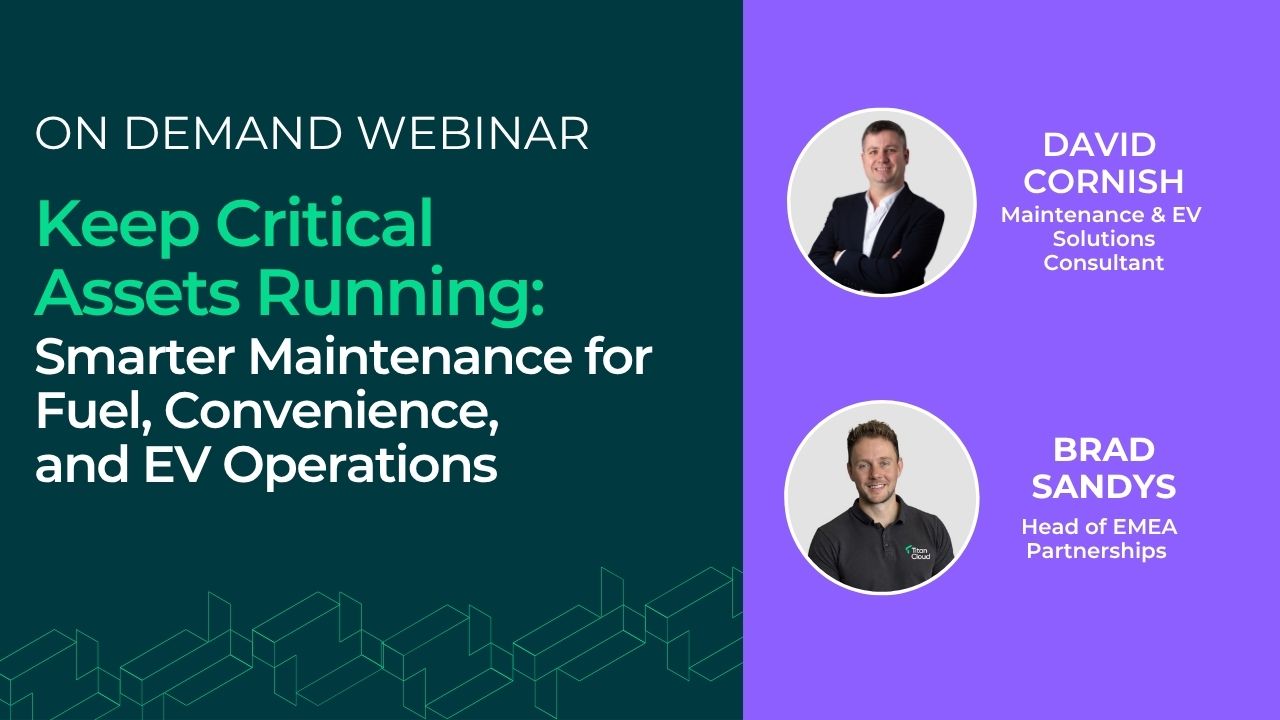
Keep Critical Assets Running: Watch On-Demand Webinar
Oct 01, 2026

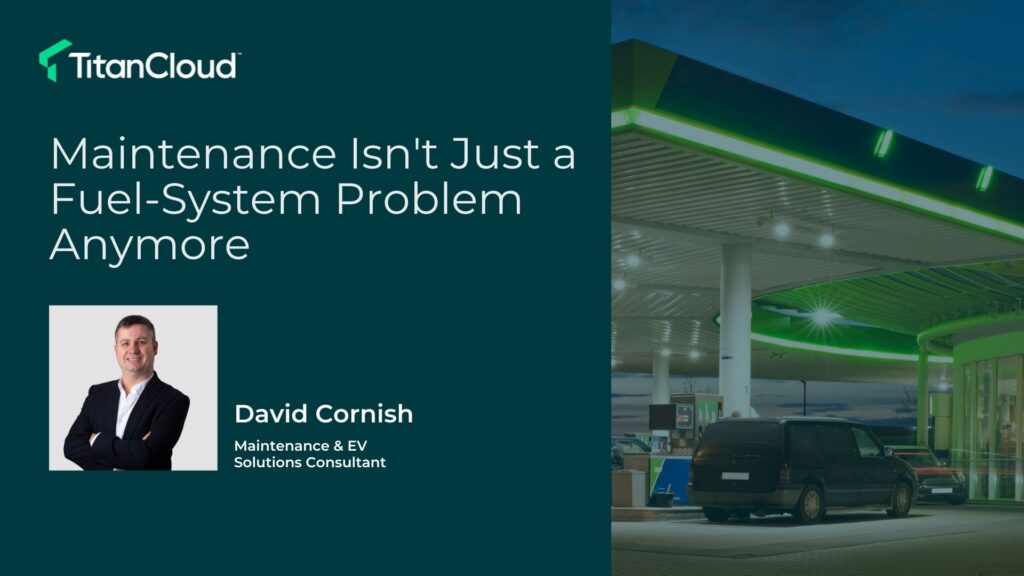
Fuel still gets people to the pump, but it’s no longer the only thing keeping a site profitable. Coffee, food service, car wash, and increasingly EV charging all play a real role in a site’s revenue and customer experience today – and each one is another asset that has to be working when a customer shows up. That shift is exactly what Brad Sandys and I unpacked in our recent webinar, Keep Critical Assets Running: Smarter Maintenance for Fuel, Convenience, and EV Operations.
For most fuel and convenience operators, maintenance has quietly become a whole-site challenge rather than a fuel-systems one. More assets, more vendors, more complexity – and when something goes down, the impact is immediate: lost revenue, service delays, SLA gaps, and more pressure on operations teams trying to keep everything running.
Here’s how we think operators can get ahead of it.
The biggest shift we see operators make isn’t a new tool bolted onto old processes — it’s bringing assets, work orders, vendors, and warranty data into one system of record. When that information lives in one place instead of spreadsheets, inboxes, and side-channel tickets, nothing depends on someone’s memory, and every issue has real history behind it the moment it’s reported.
Invoices and costs belong in that record too: completed work is validated against the invoice, approved, and passed into the finance process without anyone copying data between systems, so maintenance spend can be tracked by asset, category, and vendor and viewed by site and region. Over time, that gives you a clear view of each asset’s lifecycle cost – its age, how often it fails, and its total maintenance cost, both reactive and planned – so you can see which assets, sites, and vendors are costing you the most.
Pumps, car washes, coffee machines, and EV chargers all have one thing in common: when they’re down, you’re not just facing a repair bill, you’re losing the sale. A connected maintenance model replaces manual, reactive dispatch with automated workflows that get the right resource to the right issue faster – protecting uptime on exactly the assets your customers are showing up for.
One of the clearest ROI levers in maintenance is dispatch accuracy: sending the right contractor, with the right information, the first time. Tracking response times, first-time fix, and repeat-visit patterns across your entire vendor network – not just site by site – turns “which contractor should we use” from a guess into a data-backed decision.
Every work order is a data point on an asset’s lifecycle. When that history is centralized, the repair-versus-replace-versus-retire decision stops being subjective and starts being something you can actually plan around, rather than react to.
As EV charging becomes part of the forecourt, chargers need the same uptime discipline as any other revenue-generating asset. Titan EV brings charger operations into the same connected platform as the rest of your maintenance program – including automated remote resets that resolve a meaningful share of charger errors without a truck roll, so charging issues get handled with the same rigor as a dispenser or a coffee machine.
You don’t need a perfect data set to build the case internally – downtime, labor hours, warranty recovery, and avoidable truck rolls are usually enough to size a credible opportunity. If you want a shortcut:
Try the Maintenance ROI Calculator
This approach is already running at real scale across Titan Cloud’s network of fuel, convenience, and EV operators worldwide, including 8 of the top 10 fuel retailers.
Brad and I go deeper on all of this in the full webinar, plus a live Q&A on KPIs, common maintenance mistakes, and integrating EV monitoring systems.
Why is maintenance no longer just a fuel-system issue for forecourt operators?
Non-fuel assets – coffee, food service, refrigeration, car wash, and increasingly EV charging – now play a major role in a site’s revenue and customer experience, so keeping those assets running matters as much as keeping the pumps running.
What is Titan Maintenance?
Titan Maintenance is Titan Cloud’s connected asset and maintenance management platform – a single system of record for assets, vendors, technicians, work orders, and costs across fuel, non-fuel, and EV assets. It replaces disconnected, manual processes with automated dispatch, work order management, e-invoicing, and reporting, and tracks maintenance spend by asset, category, and vendor – turning maintenance from a cost center into a driver of efficiency, uptime, and ROI.
What is Titan EV?
Titan EV is Titan Cloud’s EV charger maintenance solution, built as an extension to a charge station management system (CSMS) rather than a replacement for one. It gives operators a single source of truth for charger assets, warranties, and service history, automates diagnostics and issue resolution including remote resets, and provides operational visibility to improve charger availability at scale.
What KPIs should I track to know if my maintenance program is actually improving reliability?
There is no single universal set of KPIs, as this varies by operator and network. Most operators track a combination of first-time-fix rate, uptime and availability by asset category, average time to resolution, and cost per work order, then build custom reporting around the specific assets or vendors causing the most issues.
What is the most common maintenance mistake operators should stop making?
Running a ticketing system that is not connected to asset history. Without that connection, there is no way to see how often a specific asset fails, how much it is costing to maintain, or whether it is still under warranty, so every issue gets treated as if it is happening for the first time.
How can I estimate the ROI of improving our maintenance program?
Downtime recovered, labor hours saved, warranty dollars captured, and truck rolls avoided are usually enough for a credible estimate, even without a perfect data set. The Titan Maintenance ROI Calculator can help size the opportunity from there.
Can EV charger maintenance integrate with our existing charge station management system (CSMS)?
Yes. Titan EV sits alongside a CSMS rather than replacing it, using OCPP data such as fault states and error codes to trigger the right next step, from a remote reset to a field dispatch, and feeding results back into a connected resolution workflow.
How much of EV charger maintenance can actually be automated?
A meaningful amount. Automated remote resets alone resolve a significant share of charger errors without dispatching a technician.
What is Titan Cloud doing with predictive maintenance, particularly for EV charging?
Titan Cloud is building machine learning and AI profiles of customers’ chargers, by brand and network, to learn what’s normal for a given site rather than only reacting to explicit error codes. That means looking beyond straightforward faults to catch early signals like dips in usage patterns or lower power rates, so issues can be flagged before they take a charger down. EV charging is a useful starting point for this because chargers largely speak the same language, unlike dispensers and other equipment, which tend to run on more proprietary protocols and diagnostics – the same predictive approach is used elsewhere in Titan Cloud’s products too, such as detecting slow flow on fuel nozzles.