Carrier-Managed Logistics Needs More Than Communication. It Needs Control.
Jul 11, 2026


This year’s NACS Show is centered on “ROI: Return on Insight” – a fitting theme for an industry where operators are balancing labor, fueling, category management, foodservice, technology, regulatory change and evolving consumer expectations, often all at once.
In an environment this complex, more information isn’t necessarily better. Retailers need insights that help them make sharper decisions and produce measurable results. That’s especially true in fuel operations.
Fuel retailers have already invested heavily in tanks, dispensers, automatic tank gauges, sensors, leak detection systems and other critical infrastructure. Those assets generate enormous amounts of operational data every day. The opportunity is to turn that data into insight, and insight into action.
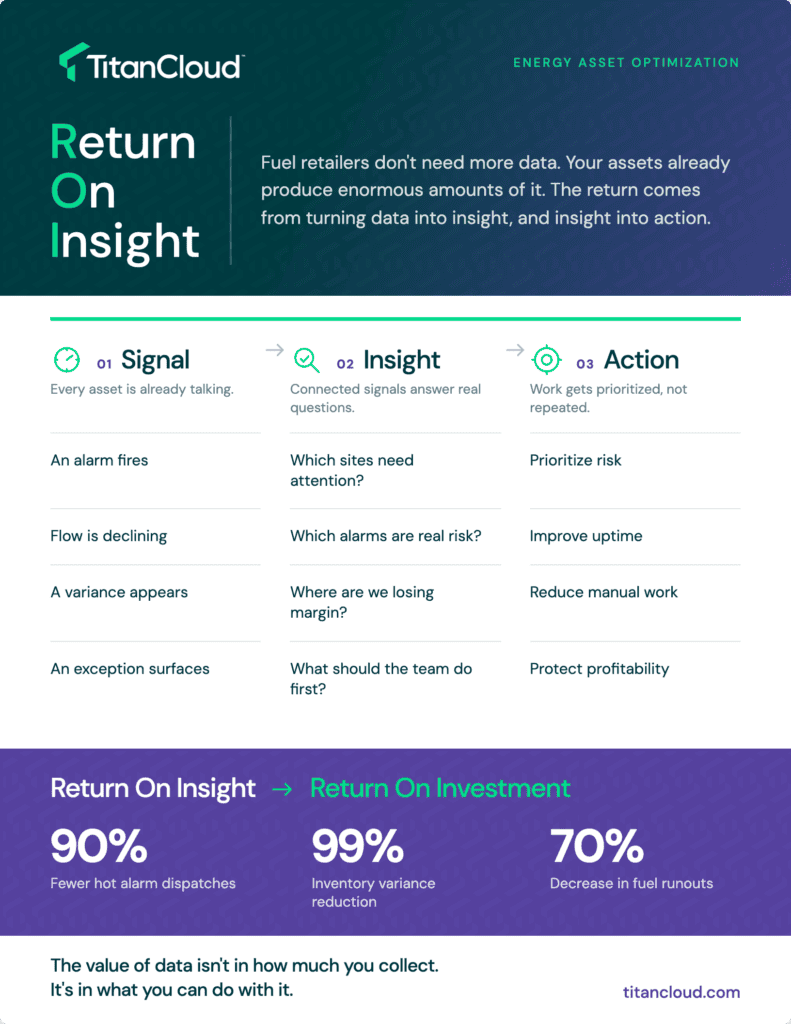
Most fuel networks do not have a shortage of data. The challenge is determining what matters. A tank gauge generates an alarm. A dispenser shows declining flow. Fuel inventory data identifies a variance. Maintenance history reveals a recurring issue. A compliance workflow surfaces an exception. Individually, each signal tells you something.
The real value comes from connecting those signals, putting them in context and helping teams understand what deserves attention first.
For me, that is where data science becomes operationally useful. The goal isn’t to give operators another dashboard full of information. It’s to help them answer practical business questions:
When data helps answer those questions, it becomes actionable insight.
Fuel operations have traditionally been highly reactive. An alarm occurs, and someone investigates. A dispenser slows down, and a customer notices. A compliance task becomes overdue, and someone starts chasing documentation. An asset fails, and a technician gets dispatched. That creates operational fire drills.
A better approach is to identify patterns, risks and exceptions earlier so teams can intervene before an issue becomes more disruptive or expensive. This is the foundation of Energy Asset Optimization. By connecting data across fuel inventory, equipment, maintenance and compliance workflows, operators can build a clearer picture of what is happening across their network, and what they should do about it.
That insight can help teams:
The value isn’t simply knowing that something happened. It’s knowing what to do next.
The NACS Show gives retailers access to new ideas, products, services and connections that can improve virtually every part of the convenience business. It also creates an opportunity to ask an important question: How much value are you getting from the technology and data you already have?
Sometimes the next operational improvement doesn’t require another piece of hardware. It requires making better use of the information your existing infrastructure already produces.
That is what Return on Insight should look like in practice.
In a fast-moving convenience environment, operators can’t afford to spend their time sorting through disconnected data and trying to determine what matters. They need insight that sharpens decisions and drives measurable results.
At NACS 2026, Titan Cloud will show how connected fuel data, analytics and operational workflows can help retailers move from reactive fuel management toward proactive asset optimization. The value of data isn’t in how much you collect. It’s in what you can do with it.
See how Titan Cloud can help your organization turn fuel operations data into actionable insights that reduce risk, improve performance and protect profitability. Book a meeting with Titan Cloud at NACS 2026 and discover what a stronger Return on Insight could mean for your fuel network.