2026 Intercharge Network Conference
Jul 14, 2026
As EV infrastructure investment accelerates across Europe, many forecourt and public charging operators are reaching a critical realisation: installing chargers is not the same as building a scalable EV business.
The first phase of the EV transition focused on deployment. Operators raced to get chargers into the ground, secure locations, and expand coverage. But as networks scale from dozens of chargers to hundreds — and eventually thousands — the operational complexity behind those assets begins to surface.
What worked at small scale no longer works when uptime expectations rise, utilisation increases, and customer tolerance disappears. The challenge is no longer infrastructure alone — it is operational readiness.
Recently, we sat down with David Cornish, Head of Solutions Architecture at Titan Cloud, and Björn Albertsson, Co-founder of Metergram, to discuss the key challenges forecourt and public charging operators face when building a scalable EV business.
These were the main takeaways:
Installing chargers is only the starting point. Operators need a plan for how those chargers will be monitored, maintained, repaired, reported on, and optimised. Once chargers are live, operators must answer a much harder set of questions:
Without clear answers, operational gaps begin to emerge quickly.
As David Cornish explains, early deployments are often manageable because assets are new, utilisation is low, and teams can compensate manually when issues arise. But as networks expand, the pressure on operations increases rapidly, and manual processes can no longer scale effectively.
Traditional fuel infrastructure is mature, standardised, and deeply operationalised. Forecourt operators have spent decades refining maintenance workflows, service models, compliance processes, and uptime management across fuel assets.
EV charging introduces a fundamentally different operational environment: new software dependencies, new service expectations, new uptime pressures, and more complex vendor ecosystems.
Operators are suddenly managing charger management platforms (CPMS/CSMS), remote diagnostics, software updates, payment integrations, roaming relationships, contractor coordination and complex vendor ecosystem. The result is a much larger dependency on connected systems working together reliably.
And when those systems fail to integrate properly, the operational consequences are immediate.
As EV networks scale, several operational bottlenecks consistently emerge.
Many operators deploy chargers alongside existing forecourt systems rather than integrating them into a unified operational model. That creates disconnected workflows where EV assets are managed separately from fuel, retail, maintenance, and field operations.
Over time, this fragmentation creates inefficiency, duplicated effort, and limited visibility across the network.
As Björn Albertsson explains, many operators discover too late that their charging infrastructure was never designed to integrate cleanly with the rest of their operational environment. “On the surface, everything looks fine. Operators have chargers in the ground and a CPMS running. But those systems were rarely designed to work together with the wider operational infrastructure. At small scale, that gap is manageable. As the network grows, it becomes a serious operational problem.”
At smaller scale, maintenance often relies on spreadsheets, emails, phone calls, and manual escalation paths. But reactive processes break down rapidly when operators manage hundreds of connectors across multiple sites.
Without automation, fault resolution slows, service costs increase, and operational teams become trapped in constant firefighting. The result is longer resolution times, higher operational costs, and reduced charger availability.
One of the biggest misconceptions in EV operations is the difference between uptime and actual availability. A charger may technically report as “online” while still being unusable to drivers due to issues like:
Operators often believe they are meeting uptime targets while customers experience failed charging sessions. “What matters is availability – and that’s where a lot of operators lose visibility as they scale”, added David Cornish.
Most charging management systems are effective at monitoring assets. But monitoring alone does not resolve operational issues.
A CSMS may identify a fault, but operators still need workflows that determine:
Without connected workflows, data becomes disconnected from execution.
As vendor ecosystems expand, operational accountability often becomes unclear.
Different systems manage payments, charger telemetry, maintenance records, and service dispatch — frequently without clean integration between them. When problems occur, systems and suppliers can end up pointing at each other rather than resolving issues quickly.
“What we also see is operators who don’t fully control their own charger data. It sits in a platform they don’t own, in a format they can’t easily extract or use. That becomes a real problem when they want to change platforms, add roaming partners, or just understand what’s happening across their network,” Björn Albertsson explains.
Ultimately, drivers do not care about backend architecture or operational complexity. They care whether a charger works when they arrive.
Poor availability damages trust quickly, and in an increasingly competitive charging market, unreliable experiences directly impact revenue and loyalty.
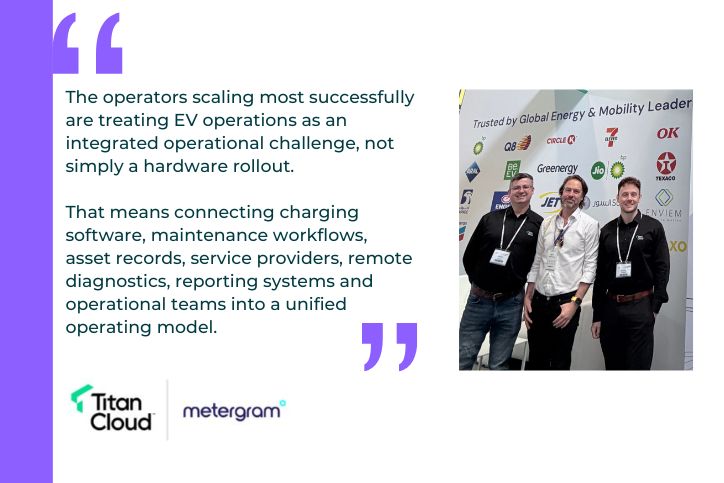
The operators scaling most successfully are treating EV operations as an integrated operational challenge, not simply a hardware rollout.
That means connecting charging software, maintenance workflows, asset records, service providers, remote diagnostics, reporting systems and operational teams into a unified operating model.
When systems are properly connected, operators can automate critical processes such as fault detection, issue triage, remote remediation, work order creation, contractor dispatch and performance reporting.
This shifts operations from reactive to proactive. It also enables scalability without relying on proportional increases in headcount.
As Björn Albertsson notes, many of the operational issues operators face today stem from early integration decisions that were treated as technical afterthoughts rather than strategic architecture choices. The longer those gaps remain unresolved, the more difficult and expensive they become to fix.
This is where Titan Cloud and Metergram are helping operators rethink EV operations.
Titan EV focuses on operational execution — helping operators automate maintenance workflows, improve fault management, and increase charger reliability across large-scale networks.
Metergram brings expertise in system architecture, integration strategy, and operational readiness — helping operators design connected ecosystems that support long-term scalability rather than short-term deployment.
Together, the focus is not simply on adding more chargers. It is about helping operators build an EV operating model capable of supporting reliability, uptime, and sustainable growth.
The next phase of EV infrastructure growth will not be won by charger count alone. It will be won by operators who can run reliable, scalable, and integrated charging operations.
As EV networks mature, operational excellence will become the true differentiator, determining which operators can maintain customer trust, control costs, and scale efficiently. Infrastructure may start the journey. But operations determine whether the business scales successfully.
If your organisation is scaling EV infrastructure and starting to feel the strain of disconnected systems, reactive maintenance, or inconsistent uptime, now is the time to rethink the operating model behind the network. Talk to Titan Cloud and Metergram about building an EV operating model designed for reliability, uptime, and scale. Connect on-site with the team at Intercharge Network Conference 2026.
What is the biggest operational challenge for EV charging networks today?
For many operators, the biggest challenge is no longer deploying chargers but operating them efficiently at scale. As networks grow, managing maintenance, fault resolution, contractor coordination, and system integration becomes increasingly complex. Without connected operational workflows, maintaining high charger availability becomes difficult.
What is the difference between charger uptime and charger availability?
Uptime generally refers to whether a charger is online and communicating with the charging management system (CSMS). Availability measures whether drivers can successfully use the charger. A charger may appear online while still being unavailable because of issues such as damaged connectors, payment terminal failures, communication errors, or other faults that prevent successful charging sessions.
Why do EV charging operators need more than a CSMS?
A Charging Station Management System (CSMS) provides visibility into charger status and performance, but it does not typically manage the full operational response. Operators also need workflows that automate fault triage, remote diagnostics, work order creation, contractor dispatch, warranty management, and repair verification to resolve issues quickly and efficiently.
Why is system integration important for EV charging operations?
EV charging relies on multiple systems working together, including charging management platforms, payment systems, maintenance software, asset management tools, and field service providers. Integrating these systems helps eliminate manual processes, improves visibility across the network, and enables faster issue resolution as operations scale.
Why do maintenance processes become more difficult as EV networks grow?
Manual processes such as spreadsheets, emails, and phone calls may work for a small number of chargers but quickly become inefficient as networks expand. Larger charging networks require automated workflows that prioritise faults, assign work orders, track contractor performance, and provide real-time operational visibility.
How can operators improve charger availability?
Improving availability requires more than responding to faults after they occur. Operators should combine real-time monitoring with automated maintenance workflows, remote diagnostics, preventative maintenance, and integrated reporting to identify issues earlier and resolve them more efficiently.
How are Titan Cloud and Metergram helping EV charging operators?
Titan Cloud helps operators improve charger reliability by automating maintenance operations, fault management, contractor coordination, and service workflows. Metergram helps organisations design and integrate the connected operational architecture needed to support scalable EV charging networks. Together, they help operators build an operating model focused on reliability, operational efficiency, and long-term growth.
What is Metergram?
Metergram is a specialist EV charging software consultancy with a team of 50 working exclusively in the EV charging domain. We work with charge point operators, platform vendors and eMSPs across Europe and North America on integrations, platform migrations, and protocol implementation across OCPP, OCPI, OpenADR and ISO 15118.
How can I contact Metergram?
Visit www.metergram.com or, if you’re attending the Intercharge Network Conference 2026, you can meet Metergram and Titan Cloud on-site to discuss charger reliability, operational efficiency and network scalability.