Nov 04, 2025
Smarter Routes, Fuller Loads: How Fuel Distributors Are Using AI

Read More

And right now, that challenge is getting harder. Ongoing conflict in the Middle East and renewed risk around key shipping lanes have amplified crude and product volatility — pushing fast intraday moves and tightening the window to capture margin. In this environment, “best buy / spot buy” decisions can’t be a quick price check. They have to be a repeatable, risk-aware operating discipline.
In fuel supply and logistics, that prioritization problem shows up in a familiar place: best buy / spot buy decisions.
Every day, procurement and supply teams face a deceptively simple question: Where do I lift fuel — and from which supplier — to meet demand at the lowest cost? That “one decision” can involve multiple terminals, multiple suppliers per terminal, different contract positions, and day-deal opportunities — and the variables change throughout the day.
Fuel prices move fast, and margin opportunities open and close quickly. The signals that drive those shifts — benchmarks, intraday rack moves, allocation exposure, and freight swings — are often buried in technical market data. Most operators don’t have the time (or the tools) to constantly track those inputs, interpret what changed, and translate it into the next best action. In a volatility cycle, “next” can mean right now.
This is exactly why Titan Cloud takes this approach to Best Buy Intelligence: to help fuel operators make the highest-confidence “best buy” decisions using the fully loaded cost – not just the posted rack price.
At first glance, best buy feels like a classic optimization problem: compare prices, pick the cheapest option, move on. But in real fuel operations, price is only the starting point. Best buy is a decision with three conflicting sets of needs:
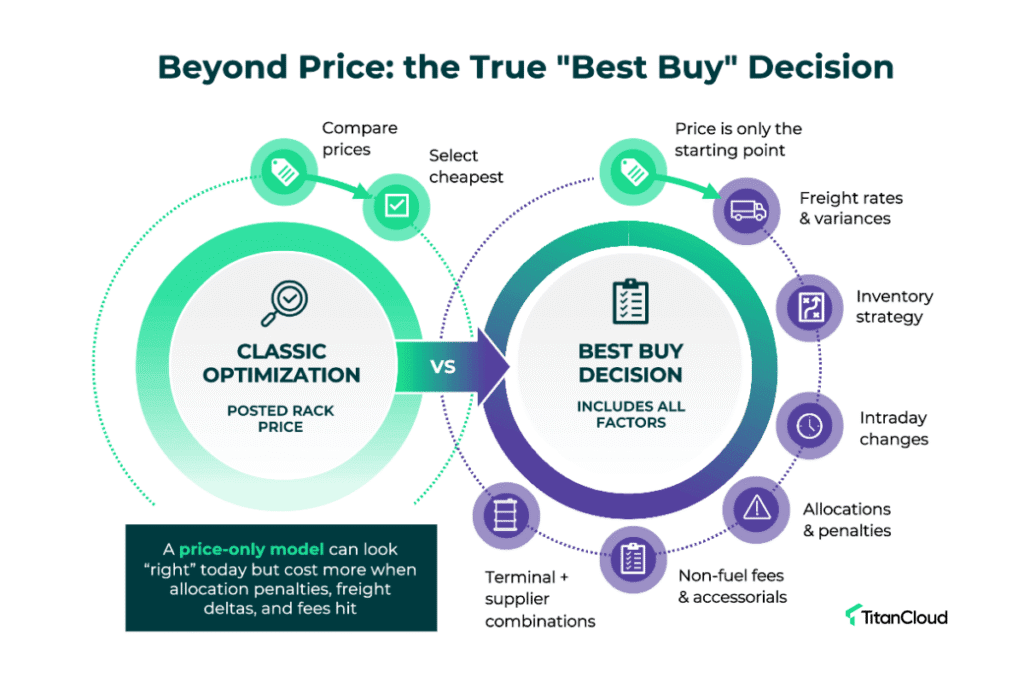
To make a true best buy decision, a retailer must incorporate many inputs, including:
This is why best buy tools can deliver very different results. A price-only recommendation can look “right” today – and still cost more when allocation penalties, freight deltas, and fees hit.
Titan Cloud’s point of view is simple: Best Buy Intelligence = the lowest cost, given real-world constraints. In other words, the “best buy” isn’t the lowest rack price or lowest contract price — it’s the option that minimizes fully loaded (real landed) cost while staying aligned with allocations and execution realities.
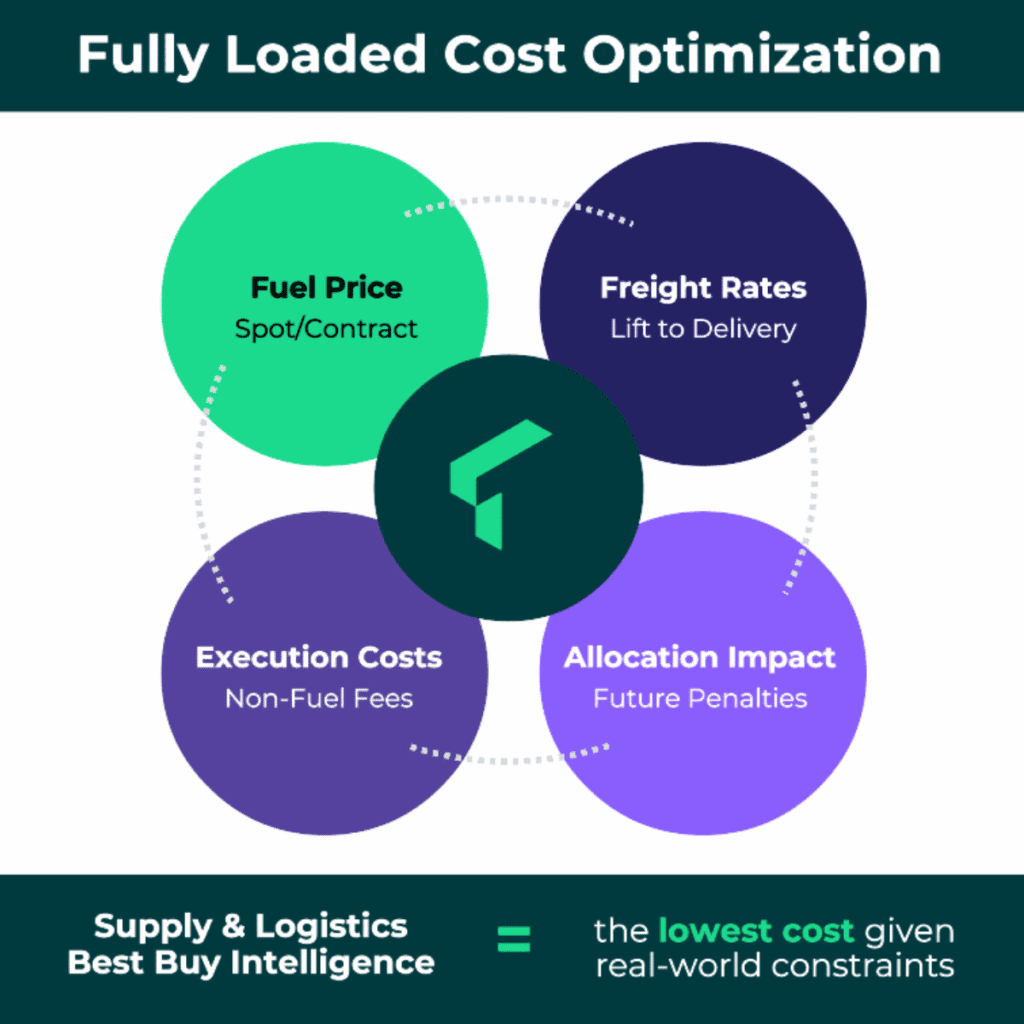
A fully loaded view includes:
Allocations matter because they “nest” across multiple time windows (daily through annual). That means every lift affects what’s possible — and profitable — next.
Best buy isn’t a one-time calculation. Each load choice changes allocation fulfillment and future optionality, so Titan Cloud recalculates real landed costs and recommendations after every decision — whether you’re optimizing one load or hundreds. The result: you’re optimizing the sequence of loads over time, not just picking the cheapest load in isolation.
Here’s the counterintuitive truth many teams learn the hard way: A “great deal” today can cause a bad outcome later. If you chase the lowest price repeatedly without accounting for allocation progress, you can drift off-track — then pay for it in penalties or costly corrective lifting at the end of the period.
That’s why a real best buy engine needs to answer two questions at once:
This is one of the clearest differentiators between “tools that show pricing” and “systems that optimize outcomes” — especially when volatility compresses decision cycles and increases the cost of being wrong.
Most operators aren’t short on data—they’re short on integration: prices, freight, surcharges, allocations, and forecasts live in different places, forcing buyers to stitch decisions together under pressure. That’s why Best Buy Intelligence isn’t a single data feed; it’s a decision system. Titan Cloud unifies four capabilities into one workflow.
The engine evaluates the full economics of each option: fuel price + freight + fees, so buyers see the “real” cost, not just the visible cost.
Titan Cloud tracks allocation position while recommending the lowest-cost moves within those constraints, so your strategy remains viable over the full period, not just the next load.
Beyond tracking allocation, Titan Cloud incorporates potential penalties and the probability of incurring them into fully loaded cost calculations — allowing buyers to make decisions that balance savings with contractual and financial risk.
If demand is likely to rise (seasonality, holidays, events, weather, local patterns), the best buy decision changes. Titan Cloud’s approach includes demand/consumption-based forecasting and the ability to respond to market movement (load shifting) when prices roll intraday.
Together, these capabilities support the outcomes operators care about most: lower COGS, smarter freight spend, fewer execution errors, and better service levels without over-tying working capital.
A practical way to evaluate best buy decisions: weigh cost impact, time sensitivity, and confidence. Even in procurement, this framework applies. Sometimes the lowest posted price isn’t the best buy if confidence is low (uncertain fees, uncertain lift adherence, unclear allocation position) or if urgency is high and supply risk is elevated – conditions that become more common during geopolitical disruption.
Best Buy doesn’t just answer “who has the best price?” — it shapes how fuel gets delivered. A true best buy recommendation influences where trucks lift (terminal choice), which supplier/product code is pulled at the rack, and when loads should move (or shift) as prices and inventory needs change. It also affects routing and capacity: the “best” option has to account for freight economics, driver/carrier constraints, and allocation commitments that span daily through monthly windows. And here’s the key: each executed load changes what’s best next. Allocation fulfillment and remaining contract positions shift after every decision, so the system has to continually re-optimize — not just pick the cheapest load in isolation.
Buying fuel is easy; buying it strategically is not, especially when volatility is driven by geopolitical risk and intraday markets move faster than manual workflows can. Best Buy Intelligence is where supply economics and logistics execution finally operate as one system. It doesn’t just surface the lowest price, it recommends the best move based on real landed cost, allocation realities, and what your network actually needs next, then updates those recommendations as each load is executed and the math changes. The result is a smarter way to buy and move fuel: fewer “price-only” decisions, fewer avoidable surprises at month-end, and a clearer path to consistent, repeatable savings, without adding more noise to the day-to-day.
Learn more about Titan Cloud’s Supply & Logistics Solutions