Jan 29, 2026
Q&A with David Cornish, Maintenance & EV Solutions Consultant

Read More

Fuel operators everywhere are under the same pressure: keep sites running, minimize risk, and prove the work was done. The terminology varies by region – some teams talk about “compliance,” others talk about “environmental performance,” “risk management,” or “audit readiness.” But the operational truth is universal: Maintenance and Compliance are two sides of the same loop.
When that loop is broken – when work happens in one place and proof lives in another – you don’t just lose time. You create delays, blind spots, and a constant dependency on people to connect the dots.
A pattern I see across multi-site networks is the same: maintenance runs in one system, compliance records live in another, and teams become the integration layer. Someone spots an exception.
Then they:
That’s the swivel-chair problem. And the real risk isn’t “extra clicks.” It’s that a human has to notice the issue, translate it into action, and remember to close the loop. That dependency doesn’t scale – especially across geographies, vendors, languages, and varying levels of site maturity.
Operational maturity isn’t just better dashboards or cleaner forms. It’s designing a system where exceptions trigger action automatically – so you’re not dependent on someone catching it in the first place.
With Titan Compliance and Titan Maintenance working together to close the loop, key events can automatically generate an activity or work order and dispatch it. No manual step is required. Triggers include:
When Titan Compliance and Maintenance are used together, you’re not just reducing effort, you’re reducing exposure.
Two concrete examples illustrate the difference between basic workflow tools and a closed-loop operation.
These are the moments that separate “we have a process” from “we have operational guardrails.”
Auto-dispatch is powerful, but it’s only half the story. The other half is what comes back. A closed loop isn’t just “work got done.” It’s “here’s what the technician found and did.”
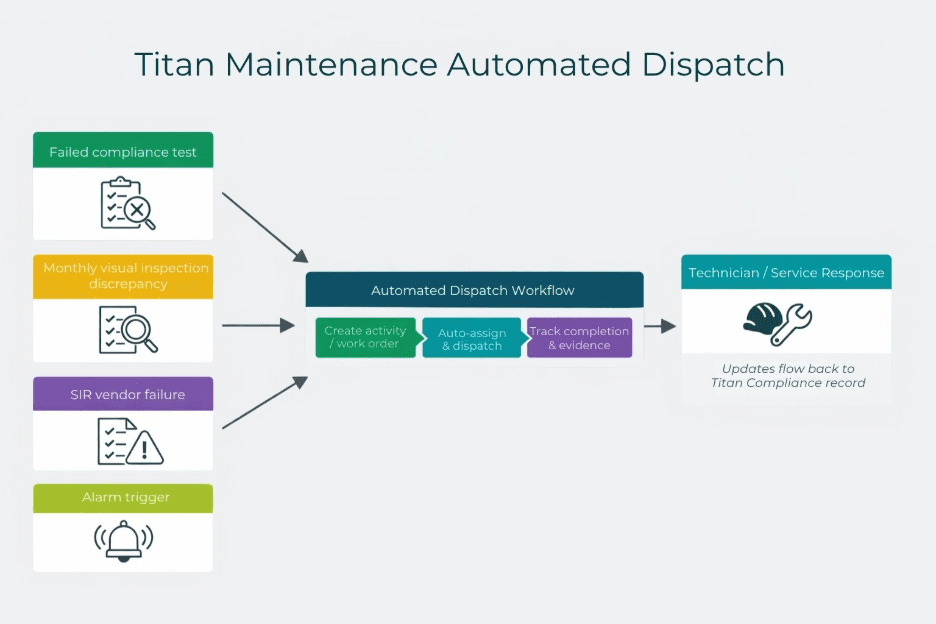
When teams use Titan Maintenance, technician notes flow back into Titan Compliance so the record reflects reality:
That’s what audit readiness looks like in practice: not a scramble to reconstruct events, but a traceable chain from exception → action → evidence.
In many regions, the conversation is less about “compliance” and more about:
Titan Compliance supports documentation and accountability across the globe. Titan Maintenance drives the execution side. Together, they reduce the operational drag of manual coordination and reduce the risk of missing critical events.
There isn’t one right sequence. The best path depends on what you already have, what’s manual today, and where your biggest handoff risk sits. Many organizations start with Titan Compliance to establish consistent records, inspections, and governance, then layer in Titan Maintenance to automate dispatch and close the loop end-to-end. Others start where operational disruption is highest (alarms, leak detection exceptions, recurring maintenance) and connect Titan Compliance immediately so proof is captured as work happens.
The decision I’d optimize for is simple: Which starting point removes the most human dependency the fastest?
If maintenance and compliance live in separate worlds, your teams become the integration layer. That’s expensive, slow, and risky. The better model is a closed-loop operation where:
That’s how you protect uptime, reduce risk, and support sustainability and governance goals – all at the same time.
If you’re looking to reduce downtime, strengthen audit readiness, and remove manual handoffs, let’s talk.
Request a demo of Titan Maintenance + Titan Compliance.