Aug 04, 2025
Get More from Your Wetstock Management: Why It’s Time to Upgrade to Titan Cloud

Read More


Fuel retailers today operate some of the most data-rich environments in the downstream energy sector. Tanks, dispensers, environmental monitoring systems, and point-of-sale platforms generate continuous streams of operational data across every site.
In theory, that level of visibility should make it easier to understand fuel performance across a network. In practice, many retailers are still working to separate meaningful signals from operational noise, especially when it comes to fuel variance.
Operators across Europe are asking many of the same questions. What level of fuel variance is typical across a network? How frequently should meter drift be investigated? How much time should teams realistically spend reconciling fuel data and investigating discrepancies?
Even small differences between delivered, stored, and dispensed fuel volumes can have a significant monetary impact when multiplied across a network of sites. In a business where margins are measured in cents per liter, those small percentages matter. A variance of 0.3 to 0.7 percent, often considered within normal industry ranges, can represent significant losses depending on fuel volumes and network size.
Fuel variance rarely comes from a single cause. More often it reflects a mix of operational and technical factors such as meter drift, delivery discrepancies, temperature effects, reconciliation gaps, or fuel theft. Most operators know these risks well. The challenge is determining which issues are driving discrepancies across a network and whether current processes are surfacing the right signals quickly enough.
To better understand how retailers are managing these challenges, Titan Cloud has launched a fully anonymous Wetstock Management Industry Leaders Survey and is inviting fuel professionals across Europe to participate.
The survey gathers input from professionals working across fuel operations, inventory management, compliance, IT, and finance. It explores topics such as fuel inventory variance, investigation practices for theft and meter drift, dispenser testing frequency, reconciliation workflows, and the tools teams rely on to monitor wetstock performance.
The goal is to build a clearer set of industry benchmarks and provide retailers with meaningful context for evaluating their own operations.
Survey Focus Areas:
Every site produces a steady stream of readings, alarms, and reports from tanks, dispensers, environmental systems, and point-of-sale platforms. While that visibility should make it easier to understand what is happening across a network, the volume of signals can quickly create noise.
Teams see discrepancies and variance reports every day, but determining what truly requires attention is not always straightforward. Is a certain level of variance typical? How often should meter drift be investigated? Are operational teams spending the right amount of time reconciling fuel data?
Benchmarking provides context that is often missing. Seeing how other retailers approach wetstock management helps operators understand whether their variance levels are typical, how peers investigate issues, and where operational effort is best focused.
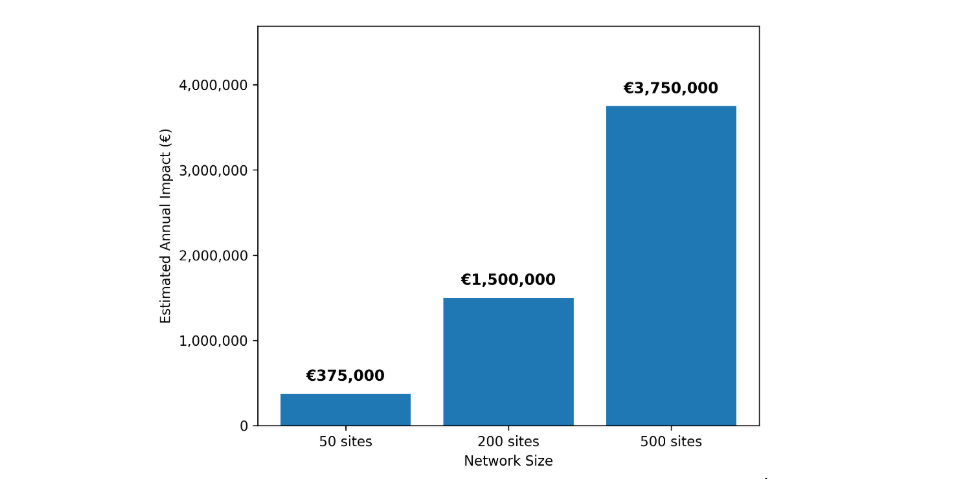
What Does 0.5% Fuel Variance Mean Across a Network?
Many fuel retailers are beginning to take a closer look at how operational data is used across their networks. Platforms that connect wetstock monitoring, compliance, maintenance, and operational workflows give teams a more complete view of site performance.
When tank data, dispenser performance, delivery records, and operational alarms can be analyzed together, patterns begin to emerge that might otherwise go unnoticed. Alerts can be prioritized more intelligently; investigations move faster, and teams spend less time digging through routine discrepancies.
As analytics tools continue to evolve, operators are also gaining earlier insight into anomalies that may signal larger issues. For retailers managing distributed networks, the ability to move from raw data to operational insight can make a meaningful difference in both efficiency and financial performance.
While many fuel retailers are making progress toward more data-driven operations, the industry still lacks a clear view of how wetstock management practices compare across networks. To help close that gap, Titan Cloud launched the Wetstock Management Industry Leaders Survey, gathering perspectives from professionals across fuel operations, inventory management, compliance, IT, and finance.
The survey explores areas such as fuel inventory variance levels, investigation practices for theft and meter drift, dispenser validation frequency, reconciliation workflows, and the time teams spend investigating discrepancies across their networks.
Your input will help shape an industry benchmarking report that gives fuel retailers insight into how their operations compare with peers and where opportunities exist to reduce losses and improve efficiency. The more operators who contribute, the more valuable the benchmark will be for the industry. The findings will be published in a report that offers a clearer view of how fuel retailers across Europe are managing wetstock performance and fuel variance today.