Aug 04, 2025
Get More from Your Wetstock Management: Why It’s Time to Upgrade to Titan Cloud

Read More

Across APAC, fuel retailers are under pressure to run more efficient, resilient networks. Many are managing remote locations, mixed site infrastructure, rising customer expectations, and tighter demands for operational visibility. At the same time, many still rely on disconnected systems to manage maintenance, fuel data, and site performance. That makes it harder to spot problems early, respond quickly, and operate proactively.
In my conversations with operators across the region, three issues come up repeatedly: unplanned downtime, fuel variance, and fragmented systems.
When a site issue happens, the biggest delay is often not the repair. It is figuring out what went wrong.
Teams may need to check several systems, contact multiple vendors, or manually piece together data before they can identify the root cause. For operators managing large or geographically dispersed networks, that lag can quickly affect uptime, customer experience, and profitability.
This is why unified data matters. When maintenance activity and fuel insights are visible in one place, operators can identify issues faster, improve coordination, and move from reactive troubleshooting to more proactive operations.
For many fuel retailers in APAC, maintenance visibility and fuel analytics are two of the fastest ways to improve performance.
When a dispenser, tank gauge, or monitoring system underperforms at a busy site, the impact is immediate, especially in high-volume urban markets like Bangkok, Kuala Lumpur, and Manila. Downtime reduces throughput, poor data delays decisions, and missed warning signs can quickly escalate into bigger operational issues.
With stronger maintenance visibility, teams can detect recurring equipment issues earlier, prioritize work more effectively, and reduce delays in diagnosis and repair.
With better fuel analytics, operators can identify abnormal patterns sooner, improve reconciliation, and gain a clearer view of site performance across the network.
Together, these capabilities help reduce investigation time, improve consistency, and support better operating decisions.
The Australian Association of Convenience Stores (AACS) reports that fuel retailers are under growing cost pressure, with operators increasingly focused on efficiency, profitability, and connected site performance. Titan Cloud helped a prominent Australian retailer that grew to more than 500 petrol forecourts and convenience stores after a 2019 acquisition. The retailer wanted to improve automatic tank gauge accuracy, strengthen leak-loss detection, and streamline bill of lading (BOL) reconciliation using Titan Cloud’s fuel analytics platform.
After completing their fuel analytics implementation with Titan Cloud, the retailer improved variance rates by 64%, reduced BOL reconciliation investigations by 50%, and increased delivery acceptance rates to 99%. Those gains were achieved through digital tank chart technology, near real-time anomaly detection, and remote visibility.
This shows the value of connected fuel data in a high-scale retail environment. It is not just about digitizing reports. It is about helping teams spend less time investigating issues and more time improving performance.
APAC is one of the most operationally diverse fuel retail regions in the world. Like Australia, APAC fuel leaders are emphasizing automation, integration, and data-driven decision-making as core priorities (ACAPMAg).
Some operators manage remote or rural networks where long maintenance response times make early visibility essential. In markets like Indonesia, geographic complexity adds another layer of difficulty. Others operate dense urban networks with heavy traffic, complex logistics, and diverse equipment vendors. In both environments, disconnected tools slow response times and make standardization harder.
Standardization should not mean forcing every operator to work the same way. It should mean giving them a consistent data foundation that supports local realities while making it easier to manage sites, assets, and workflows at scale.
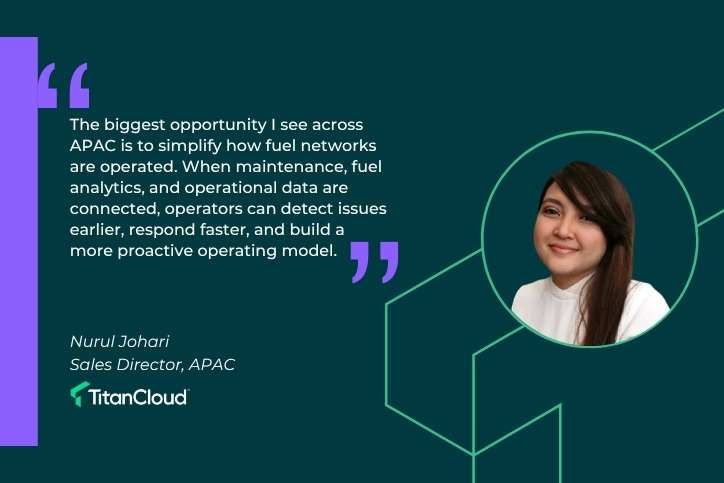
The biggest opportunity I see across APAC is to simplify how fuel networks are operated.
When maintenance, fuel analytics, and operational data live in separate systems, teams lose time and visibility. When those insights are connected, operators can detect issues earlier, respond faster, and build a more proactive operating model.
For fuel retailers looking to reduce downtime, improve fuel visibility, and operate with more confidence, the answer is not adding more disconnected tools. It is connecting the right data so teams can act on it faster. That is where real operational transformation starts.
Explore Titan Cloud’s fuel analytics and maintenance solutions to see how a unified platform can help simplify operations across your APAC network.