Aug 04, 2025
Get More from Your Wetstock Management: Why It’s Time to Upgrade to Titan Cloud

Read More

Europe’s fuel retail ecosystem is vast and operationally complex. Across the EU, UK, Norway, Switzerland and Turkey there are more than 140,000 service stations (Fuels Europe), each requiring consistent monitoring of fuel inventory, equipment uptime, and compliance requirements.
At the same time, the industry is evolving fast: Margins are tightening, regulation is increasing, EV infrastructure is expanding and operational complexity is rising across every network. In this environment, success increasingly depends on how quickly operators can turn operational data into actionable insight.
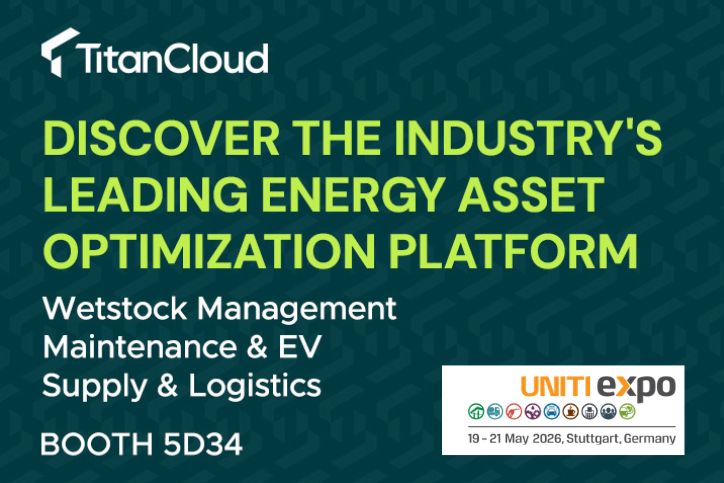
At UNITI Expo 2026 in Stuttgart, Titan Cloud will show how leading fuel and mobility companies are putting these strategies into action. If you’re attending, explore five trends reshaping the industry—and see why Booth 5D34 deserves a stop on your agenda.
Fuel losses often hide in plain sight. Slow flow rates, nozzle-down events, unexplained variance and meter anomalies can quietly erode profitability when operators lack timely visibility.
More operators are now using real-time monitoring and fuel analytics to spot issues earlier and act faster. With tools such as digital tank charts and automated variance analysis, teams can quickly identify:
The financial and operational impact can be significant. One retailer achieved a 64% reduction in tank gauge calibration variances, improved automatic bill-of-lading reconciliation by 5%, and reduced investigations by 15%, freeing teams to focus on higher-value work.
At UNITI Expo, visitors can run a personalised ROI analysis with Titan Cloud experts to estimate the opportunity across their own operations.
Managing maintenance across modern forecourt networks is no small task. In Germany alone there are more than 14,000 service stations (Fuels Europe), each operating multiple dispensers, tanks, sensors, and payment systems that must remain compliant and operational.
For many operators, maintenance has long been fragmented, spread across spreadsheets, phone calls and disconnected systems. That gets harder to manage as networks grow and day-to-day demands increase.
Operators are now implementing centralized platforms that make it easier to:
Together, these capabilities help operators repair issues faster, reduce unnecessary dispatches, and improve visibility across every site.
As fuel retailers expand into EV charging, many are finding that charger networks bring the same operational demands as traditional fuel assets. Uptime, maintenance responsiveness and a consistent customer experience matter just as much.
In 2025, hybrid vehicles accounted for 34.5% of vehicle sales in Europe, while petrol cars accounted for 26.6% (TechRadar). With charging networks expanding, operators face new challenges, including:
When a charger goes offline, the problem usually traces back to power, payments, or communications. Roughly 70% of breakdowns can be fixed remotely, while the other 30% need an on-site engineer. Automated maintenance workflows help operators respond faster by reducing manual triage, accelerating dispatch, and restoring charger availability sooner.
Operators that bring the same data-driven operational rigor to EV networks that they already apply to fuel assets will be in the strongest position to scale reliably and grow over the long term.
AI in fuel and retail operations has moved beyond theory to solve real operational problems. The real value is in using it where it can cut manual effort, improve consistency and help teams make better decisions more quickly.
That is starting to happen in a few practical ways:
The longer-term opportunity is a more connected operation, where insights do not just sit in dashboards, but help drive action across fuel, maintenance and retail workflows.
As operations become more connected, partnerships are playing a bigger role in helping operators get more value from their technology investments.
At Titan Cloud, we’re proud to be working closely with leading technology and equipment partners across Europe, including Alvic in Spain, Petrotec in Portugal, and Petroassist in the UK, to deliver deeper integration and operational value for our customers.
By bringing together data, equipment and workflows more effectively, operators gain a clearer understanding of fuel performance across their sites and can address issues before they affect the business. In a complex operating environment, that kind of connected visibility is becoming increasingly important.
UNITI Expo remains one of the most important gatherings for the European fueling and mobility ecosystem. For Titan Cloud, it’s a great opportunity to meet customers, partners, and industry leaders to discuss how data and technology can transform operations.
At Booth 5D34, visitors will be able to:
If you’re attending UNITI Expo in Stuttgart, stop by and see how Titan Cloud is helping leading energy and mobility companies turn operational data into measurable results.